
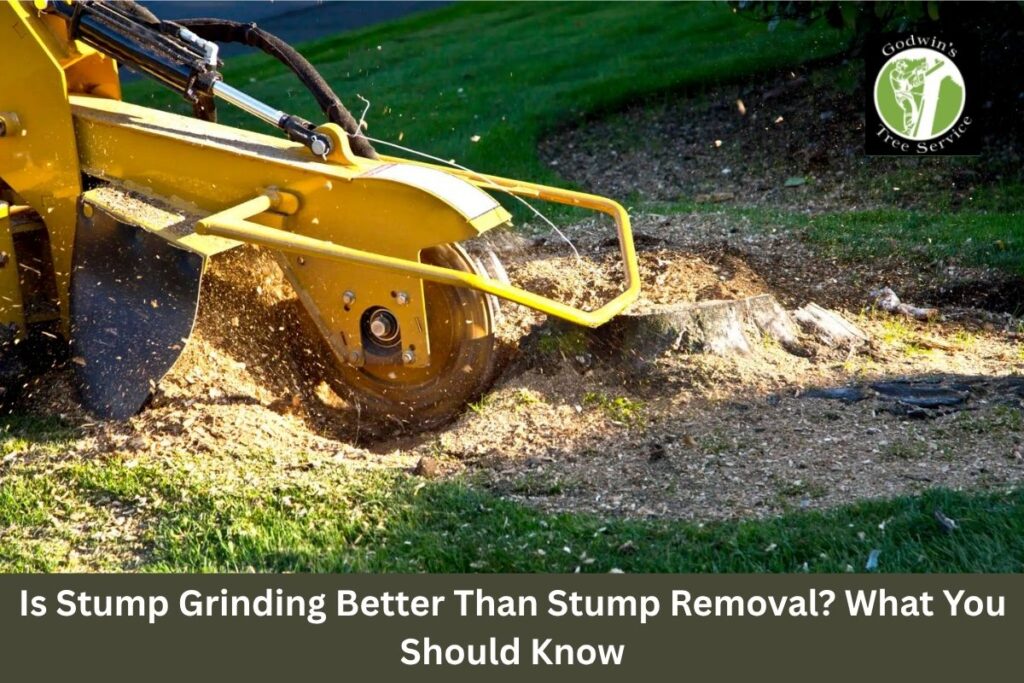
After someone cuts down a tree, the stump left behind can quickly become a problem. It may not seem urgent at first, but over time it can affect how your yard looks and functions.
At this point, most homeowners face a common question: should you grind the stump or remove it completely?
Both options deal with the stump, but they work in different ways and give different results. Choosing the right one depends on your yard, your plans, and how deep you want the job to go.
What Is Stump Grinding?
Stump grinding focuses on breaking the stump down into small wood chips using a machine. Instead of pulling the entire root system out, the stump is ground below the surface.
This process usually removes the visible part of the stump and leaves the roots underground.
After grinding:
- The area is level with the ground
- Wood chips remain in place or can be cleared
- The space can be reused for grass or plants
It is a common choice for homeowners who want a quick and less disruptive option.
What Is Stump Removal?
Stump removal takes out the entire stump along with the root system. This process goes deeper into the ground and clears everything connected to the tree.
Unlike grinding, removal leaves a large hole that usually needs to be filled afterward.
This method is more extensive and is often chosen when:
- You want to build or install something in that area
- The roots are causing problems
- You want to fully clear the space
Key Differences Between Stump Grinding and Stump Removal
Understanding how these two options differ can make your decision easier.
- Stump grinding removes the visible stump but leaves roots behind
- Stump removal clears both the stump and the root system
- Grinding is quicker and less invasive
- Removal takes more time and disturbs the soil more
- Grinding leaves wood chips behind
- Removal leaves an empty space that needs filling
Both methods solve the problem, but in different ways.
When Stump Grinding Makes More Sense
Stump grinding works well in many everyday situations. It is often chosen because it requires less effort and causes minimal disruption to your yard.
You may prefer stump grinding if you:
- You want the stump gone quickly
- The area will be used for grass or landscaping
- You do not want to disturb nearby structures
- The roots are not causing visible issues
Since the roots remain underground, they will slowly break down over time.
When Stump Removal Is the Better Option
In some cases, removing the entire stump is the better choice. This is especially true when the roots are affecting your property.
You may need stump removal if:
- You plan to build or install something in that spot
- Roots are interfering with foundations, pipes, or driveways
- The tree has aggressive root growth
- You want to completely clear the area
This method gives a clean start but requires more work afterward.
Cost Differences Homeowners Should Know
Cost is often a deciding factor when choosing between grinding and removal.
Stump grinding usually costs less because
- It takes less time
- It requires smaller equipment
- It does not involve digging out roots
Stump removal may cost more because
- It involves deeper work
- Heavy equipment may be needed
- Soil repair is required after removal
The final cost depends on the size of the stump, location, and root system.
Impact on Your Yard
Each option affects your yard differently.
With stump grinding:
- The ground remains mostly intact
- There is less disruption to nearby plants
- The area can be leveled quickly
With stump removal:
- A large hole is left behind
- Soil needs to be replaced
- The surrounding area may be disturbed
If your yard is already landscaped, grinding is often the less disruptive choice.
What Happens to the Roots?
One of the most significant differences between the two methods is how roots are handled.
In stump grinding:
- Roots stay underground
- They break down naturally over time
- No major digging is required
In stump removal:
- Roots are pulled out
- The ground is fully cleared
- No regrowth concerns remain
In most cases, leftover roots from grinding do not cause problems unless they are already affecting nearby structures.
Can a Tree Grow Back After Grinding?
In some cases, small shoots may appear after stump grinding. This depends on the type of tree.
However:
- Most stumps do not regrow significantly
- Any small growth can be removed easily
- Over time, the stump loses its ability to grow
If full removal is done, regrowth is not a concern.
Is It Safe to Do It Yourself?
Handling a stump may seem manageable, but it can be difficult without proper tools.
Challenges include:
- Operating heavy equipment
- Dealing with deep roots
- Avoiding damage to nearby areas
- Managing debris
Stump grinding machines are powerful and require careful handling. Stump removal involves digging and lifting heavy material.
Without experience, the process can be risky.
Which Option Should You Choose?
There is no single answer that fits every situation. The right choice depends on your needs.
If your goal is to clear the visible stump quickly and keep your yard intact, grinding is often enough.
In cases where you require the entire area to be cleared for construction or are facing root-related issues, opting for removal might be the more suitable choice.
Final Thoughts
Both stump grinding and stump removal deal with the same problem, but they take different approaches. Grinding focuses on removing what is visible, while removal clears everything below the surface.
Understanding your yard and future plans makes the decision easier. If the stump is simply in the way, grinding may be enough. You might want to consider removal if the roots are causing trouble or if you want a completely clean space.
For homeowners in Chesapeake, Godwins Tree Service handles both stump grinding and removal, depending on what your yard needs. If you’re unsure which option fits, it may be time to take a closer look at your property and decide what works for you.
FAQs
Yes, stump grinding usually costs less because it requires less work and does not involve removing the entire root system.
No, it removes the visible stump while leaving the roots underground to break down over time.
In most cases, it does not grow back significantly. Any small shoots can be removed easily.
It usually goes several inches below ground level, enough to remove the visible stump.
Stump grinding is often preferred if you want to keep the surrounding area intact and reuse the space quickly.